Trustpilot score across 222 reviews, the day the profile was deleted
Trustpilot built the category, ranked this company 2nd of 24 in it, then removed the profile under the one clause in its own agreement that names nothing and leaves nothing to remedy.
Trustpilot built the category, ranked this company 2nd of 24 in it, then removed the profile under the one clause in its own agreement that names nothing and leaves nothing to remedy
196Reviews recovered
222Reviews on the profile
29Countries
3Working days’ notice
0Reviews Trustpilot disputed
On 5 January 2023 Trustpilot gave The Interstellar Plan three working days’ notice that its review profile would be deleted. The profile carried a score of 4.9 across 222 reviews. Trustpilot’s own page, at that time, placed the company second out of twenty-four in a category Trustpilot itself maintains: Herbal Medicine Store.
What did Trustpilot’s own page say?
Every screenshot taken of the profile before removal shows the same header: The Interstellar Plan, a verified badge, five filled stars and the score 4.9. That figure appears on all 219 captures, across ten pages of reviews.
The right-hand panel of the profile carried Trustpilot’s own category placement, word for word:
The Interstellar Plan is 2 out of 24 best companies in the category Herbal Medicine Store on Trustpilot
Trustpilot built that category, placed the company in it, counted twenty-four companies in it, and ranked this one second. The other twenty-three were not removed.
What reason did Trustpilot give?
The removal notice was sent at 21:41 GMT on 5 January 2023. It reads, in part:
“we only work with businesses that align with our values and core beliefs … reinforced by our commitment not to do business with companies we consider to be a ‘Bad Fit’ for Trustpilot.”
“Under the terms of our agreement with you, Trustpilot has sole and absolute discretion to determine whether it considers a business to be a bad fit.”
The appeal was answered at 16:12 GMT on 9 January 2023, four days later. It restates the same standard in the same words and adds nothing further.
Across both letters, Trustpilot names the standard it applied and never once applies it to a fact. Neither letter identifies a policy provision. Neither names a practice, an ingredient, a claim or a page. Neither disputes a single review, alleges that any review was inauthentic, or invokes the review-manipulation grounds Trustpilot publishes separately. The word “review” does not appear in either letter in connection with any complaint.
How many reviews survived, and where are the rest?
196 of the 222 reviews were captured in screenshots while the profile was live. Every one is republished here word for word, beside the screenshot it came from, on its own page.
They span 29 countries and 42,579 words of customer testimony. 191 carry a visible five-star rating; the rest were captured without the star row in frame. The reviews Trustpilot deleted are not in dispute here because Trustpilot never disputed them.
26 of the 222 were not recovered. Trustpilot paged the profile at roughly twenty reviews a page; the screenshots run from page one to page ten, with pages one through nine essentially complete, two reviews off page ten, and no page beyond ten opened. Which particular reviews those 26 are cannot be determined from the screenshots alone, and no claim is made about their content.
What can be determined is that they are not reviews Trustpilot took down. The Internet Archive counted 95 reviews on this profile on 3 May 2022, and 95 of the reviews recovered here were posted on or before that date — every review that existed on the profile that day is in this archive. Had any of them been removed in the eight months that followed, that number would be lower.
Did Trustpilot remove reviews before it deleted the profile?
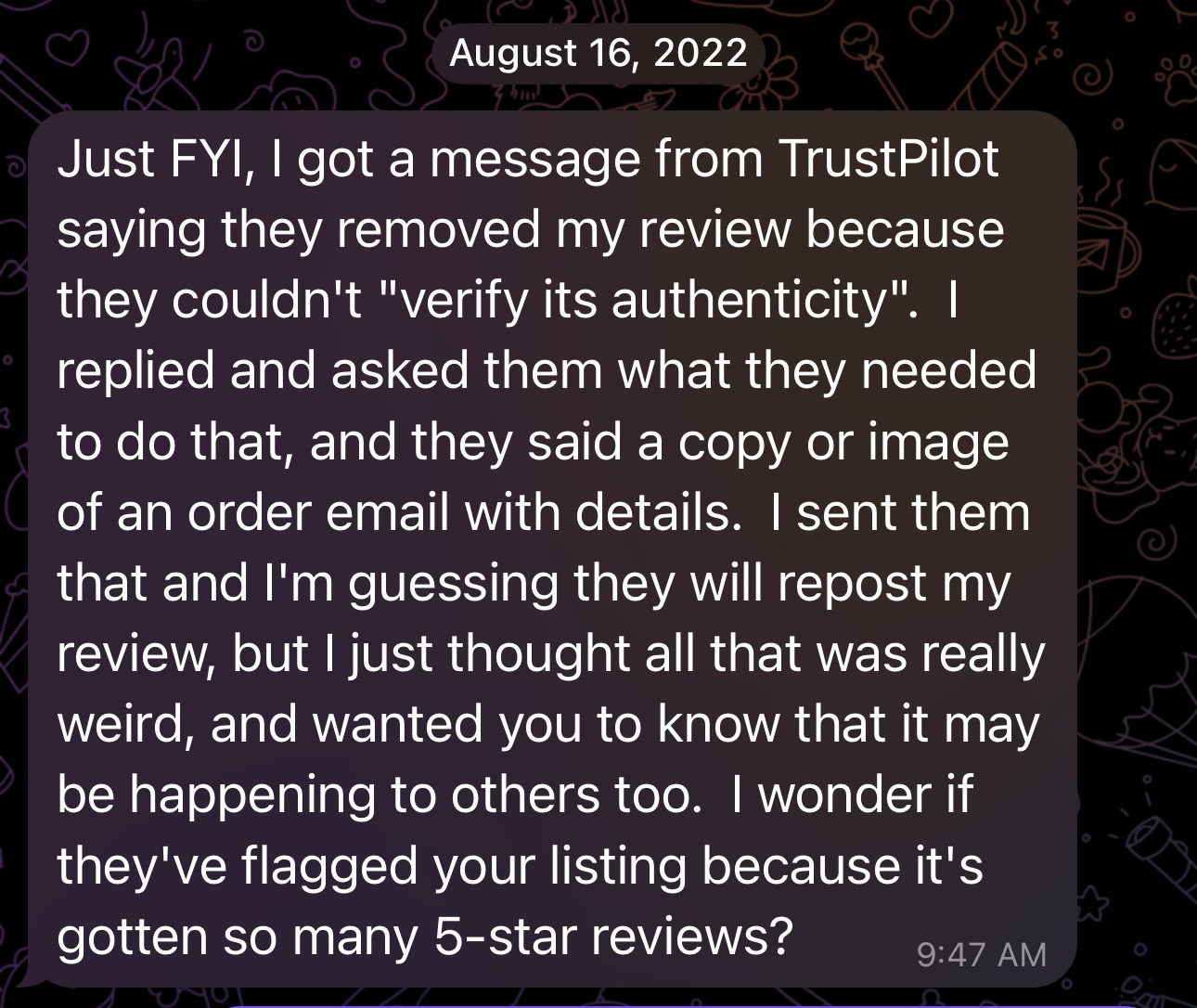
Five months before the profile was deleted, a customer wrote to the company. Her message is dated 16 August 2022, 9:47 AM:
Exhibit D — customer message, 16 August 2022.
Transcribed in full, so that it is readable without the image:
“Just FYI, I got a message from TrustPilot saying they removed my review because they couldn’t ‘verify its authenticity’. I replied and asked them what they needed to do that, and they said a copy or image of an order email with details. I sent them that and I’m guessing they will repost my review, but I just thought all that was really weird, and wanted you to know that it may be happening to others too. I wonder if they’ve flagged your listing because it’s gotten so many 5-star reviews?”
The closing sentence is the customer’s own speculation and is reproduced because it is part of what she wrote. No claim is made here about why the listing was flagged.
She reports that Trustpilot removed her review because it could not “verify its authenticity”, that when she asked what would satisfy them they requested a copy or image of an order email, and that she sent one.
The customer is Courtney Taylor. The company’s own store database holds fifteen reviews under her name, the earliest dated 2 June 2017, including a purchase Trustpilot’s own standard would call verified. Her Trustpilot review dated 9 August 2022 — one week before this message — is in this archive, captured months later while the profile was still live. Whatever was removed in August 2022 was back on the profile by the time these screenshots were taken.
Two things follow, and only these two. Trustpilot did remove at least one five-star review from this profile before deleting the profile outright. And the burden of proving a review genuine fell on the customer who wrote it, not on the platform that published it — the same platform whose letter, five months later, disputed no review at all.
This is one documented instance. It is not presented as evidence of a pattern, and no claim is made here about how often it happened.
Is any of this independently verifiable?
The Wayback Machine holds one capture of this profile, taken at 01:20 UTC on 3 May 2022, eight months before Trustpilot deleted it. It is a third-party record with no connection to this company, and it confirms the following, in Trustpilot’s own markup:
Score: 4.9
Reviews at that date: 95
Status: Verified Company, claimed profile
Rating spread: Excellent 100% — Great, Average, Poor and Bad all 0%
The archived page also carries Trustpilot’s own breadcrumb trail for the company: Health & Medical › Pharmacy & Medicine › Herbal Medicine Store › The Interstellar Plan, and states beneath the score that the company is “In the Herbal Medicine Store category”. That is a second, independent source for the category placement — filed by Trustpilot under Pharmacy & Medicine, eight months before Trustpilot removed the profile under a clause that named nothing.
Every one of the eighteen reviewers visible in that capture appears in the 196 reviews recovered here. None are missing.
And the count answers a question worth asking plainly: the profile held 95 reviews in May 2022 and 222 at removal — 127 added in eight months, with 61 of them arriving in June, July and August 2022 alone. The profile more than doubled, and five months after that peak Trustpilot deleted it. The sequence is stated here because it is a matter of record. No reason for it is asserted, because Trustpilot gave none.
Nothing in the archive suggests a campaign of deletions, and this record does not allege one.
Capture: web.archive.org/web/20220503012022/ — retrieved 21 November 2026.
Were the reviews real?
Trustpilot never disputed a single one of these reviews, so their authenticity was never the stated ground for removal. It can still be tested, and it has been.
The company keeps its own customer review database, separate from Trustpilot and predating it. Matching the 196 recovered Trustpilot reviews against that database finds 102 of them — more than half — present in both systems: 70 matched by reviewer name, 77 by the text of the review itself, 102 by one signal or the other.
These are people who reviewed the company on Trustpilot and, separately, in the company’s own store, often in the same words. Trustpilot verified no purchases. The store database records them.
Measured 21 November 2026 against two store exports totalling 2,714 rows. Name matching ignores case and punctuation; text matching requires a 60-character verbatim run in common. The other 94 are not called into question by this — a customer is under no obligation to review twice.
What else did Trustpilot’s own page say?
Where a customer had reviewed the company more than once, Trustpilot collapsed the earlier review behind a banner of its own wording:
Only the latest review will count in the company’s TrustScore
That is Trustpilot stating, on the profile itself, that it discounts reviews from the score it publishes. It is reproduced here because it bears on what a Trustpilot score measures, and it appears in the screenshots at this review among others.
What does this record not claim?
This page makes no claim that Trustpilot broke a law, breached a contract, or acted on anything other than the discretion its own agreement reserves to it. Trustpilot’s letter asserts that discretion plainly and this record takes it at its word.
A separate Trustpilot profile exists for interstellarblends.com. It is not the profile this record concerns and nothing here is a statement about it; a reader who wants to see it can look it up directly.
The figures on this page come from the correspondence and from screenshots of Trustpilot’s own pages, all retrieved and transcribed on 21 November 2026. Where a number is derived rather than quoted, it is labelled as derived on the page that uses it.
Can I check this myself?
Yes. The whole archive is published as data, not only as pages, so nothing here has to be taken on trust.
Every one of the 196 reviews appears in those files with its reviewer, country, rating, both dates, the formulas named, the full text, and the filename of the screenshot it came from. No email address and no IP address appears in any of them, and none is held on this site.
The Trustpilot correspondence is quoted in full on this page rather than shown only as an image, so it is readable by a machine as well as a person. The same is true of every review.
This record is about what Trustpilot did. It is not an advertisement, and nothing on this site is for sale. But a reader who wants to judge the company rather than the dispute can check it directly, because the company publishes the evidence behind every ingredient it sells and the rubric it grades that evidence by.
937 botanicals, each with its own page and its evidence graded
567 biological pathways mapped
68 formulas, every botanical in each one named
2,527 citations behind those grades
17,747 stated relationships across 1,698 nodes
1,178 customer reviews, each with an author and a date
2,985 pages in the public sitemap
The rubric every one of those grades is assigned by
AHuman trial evidence101of 937
Randomized human trials, or a meta-analysis of them, measuring that pathway’s own endpoint. Opens a pathway on its own.
B+Corroborated288of 937
Human data, or animal evidence replicated by an independent laboratory. Opens a pathway only alongside an independent corroborating driver.
BPreclinical503of 937
Mechanistic, cell or animal evidence. No single preclinical driver opens a pathway on its own.
CSupporting45of 937
A single bench screen, an isolated laboratory result, or a species-level listing. Shown beside the graded drivers, never opening a pathway.
A grade describes the maturity of the published science for that ingredient on that pathway. It is not a claim that any product treats, cures or is clinically proven for anything. A pathway opens only on graded, published evidence, under a standard fixed before the evidence was gathered: a grade A driver opens one on its own, a grade B+ driver only alongside an independent corroborating driver, and no preclinical driver opens one at all.
Every evidence surface, linked
How Evidence Is Graded — The four grades, the rule each one carries, and what it takes for a pathway to open.
The Evidence Against Us — Published studies that contradict the company’s own claims, found by its own research, recorded in full with their identifiers.
The Limits Register — Every gap, absence and unknown in the catalog, each with a number against it, recomputed from the corpus by a build guard.
The Falsification Harness — A runnable checker for the claim graph, published so the claims can be audited — and so the same test can be run against anyone else.
Herb–Drug Interaction Register — Four botanicals against five classes of prescription medicine, twenty cells, each with its grade, its source and the exposure it was observed at.
Certificates of Analysis — Independent laboratory results, lot by lot, with the certificate number, the laboratory, the method and the figure for every test.
The Derivation — The coverage equation, the three steps that follow from published data, and the one step that does not.
How We Search — Why a search there does not end in English, and what it takes before the site will say no evidence exists.
None of that proves a formula works, and the company does not claim it does. The narrower claim is the checkable one: the evidence is published, the method is published, and the tooling to break it is published. Figures above measured from the live site on 22 November 2026.